
Solar geyser cleaning in Fish Hoek and Cape Town
Cobus aims to reply to WhatsApp messages within an hour, Monday to Saturday, 08:00–17:00. You're welcome to send a photo or short video of your collector.
Do solar geyser panels need cleaning?
Sometimes. It depends on your roof's pitch, the weather and what lands on the glass.
SANS 10106 says maintenance of a solar geyser includes cleaning the collector glass [1].
Many solar geyser manuals say normal summer rain keeps collectors clean [2]. That advice is written for summer-rainfall areas. In Cape Town, about 78% of the year's rain falls from April to September, and only about 16% from November to March [3]. Those are long-term South African Weather Service averages for the Cape Town airport station, and the Peninsula follows the same winter-rain pattern. So your collector gets the fewest rinses in summer, when the sun is strongest.
Kwikot says its collectors should be installed at a pitch of 8° to 30°. Below 8°, they won't clean properly when it rains [2].
Rain usually keeps evacuated tubes clean, according to the Apricus owner's manual [4].
Cleaning matters most when your collector is low-pitched or sits below a bird perch. It also matters near building work or gravel roads, or after months without a good rinse. If yours is steep and well rinsed each winter, it may not need us yet. Send Cobus a photo and he'll tell you.
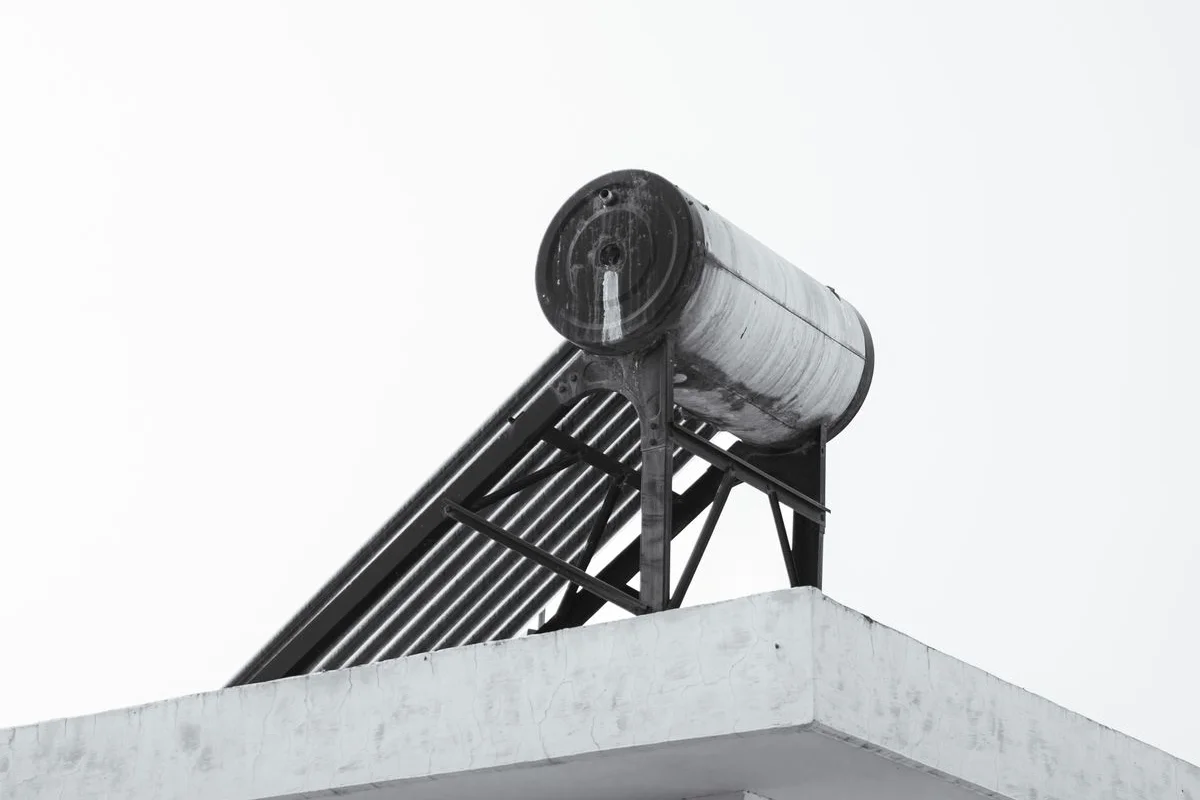
Flat-plate or evacuated tubes: what's the difference when cleaning?
A flat-plate collector has one sheet of cover glass. An evacuated-tube collector is a row of separate glass tubes, so we clean each tube on its own.
Flat-plate collector
- What it looks like
- A flat, glass-topped panel on your roof
- What we clean
- The cover glass, rinsed and brushed like a large window
- What we never touch
- The pipes, valves and tank
- What to tell Cobus
- "Flat panel"
Evacuated-tube collector
- What it looks like
- A row of glass tubes, each with a vacuum inside, joined to a pipe box (the manifold) at the top
- What we clean
- The outside of each glass tube, one at a time
- What we never touch
- The manifold, pipes, valves and tank
- What to tell Cobus
- "Glass tubes"
| Collector comparison | Flat-plate collector | Evacuated-tube collector |
|---|---|---|
| What it looks like | A flat, glass-topped panel on your roof | A row of glass tubes, each with a vacuum inside, joined to a pipe box (the manifold) at the top |
| What we clean | The cover glass, rinsed and brushed like a large window | The outside of each glass tube, one at a time |
| What we never touch | The pipes, valves and tank | The manifold, pipes, valves and tank |
| What to tell Cobus | "Flat panel" | "Glass tubes" |
Kwikot warns that the pipe carrying hot water from the collector can get extremely hot, particularly in summer [2]. Thermann's evacuated-tube manual lists a stagnation temperature (the temperature reached when no water flows) of 220 °C for its product [5]. So we never touch the manifold or the pipes.
What does a dirty collector cost you?
A dirty collector lets less sunlight through, so your geyser gets less free heat and the electric element makes up the difference. How much depends on how dirty it is.
No South African study has measured how much dirt costs a solar geyser, as far as our research found (October 2026). So we don't quote a percentage. Kwikot's manual does note that even labels left on collector glass reduce performance [2].
What do you clean, and what don't you touch?
We clean the collector glass and tubes, and nothing else.
We clean
- the cover glass of flat-plate collectors
- the outside of evacuated tubes
- dust, pollen and bird droppings on that glass, using purified water and soft brushes
- collectors on single- and double-storey homes and businesses
We don't touch
- the plumbing: pipes, the manifold, valves, the tank or the element
- draining, refilling or topping up the system
- repairs of any kind, including roof repairs and electrical work
- cracked glass or cracked tubes
- anything above double-storey
SANS 10106 says repairs must be done by, or under the supervision of, a competent person [1]. For leaks, valves, draining, refilling or no hot water, call a qualified plumber or your installer. If we see a cracked tube or cracked glass, we leave it alone and tell you.
Not sure which type you have, or whether it needs a clean? Send Cobus a photo on WhatsApp.
WhatsApp Cobus for a quoteHow do you clean without cracking the glass?
We clean when the glass is cool, keep our weight off the collector, and lift dirt with purified water and soft brushes.
Cool glass only. Hong Kong's Electrical and Mechanical Services Department advises cleaning solar collectors when they are cool [6]. Wolf warns against filling a system after its collectors have stood in direct sun, because of thermal shock (damage from a sudden temperature change) [7]. So we clean in the cooler part of the day, and never on hot glass at midday.
No weight on the collector. Kwikot's warranty doesn't cover cracked or broken collector glass or tubes, whatever the cause [2]. So we never walk on, lean on or put a ladder against a collector.
Purified water, soft brushes. We lift dirt with soft brushes and rinse it off with purified water. We never scrape dirt off dry glass. Purified water has almost no dissolved minerals, so it dries without mineral spots and needs no soap or detergent [8].
Weather can move a booking. If the roof is wet or the wind is strong, Cobus may move your clean to another day.
Can you clean my solar geyser and PV panels in one visit?
Ask Cobus in one WhatsApp message, and he'll tell you whether both can be done on the same visit. Send your suburb and photos or a short video of your solar geyser and your solar PV panels. He'll quote for the whole job before any work starts, with travel included and nothing added on the day. Read how we handle solar PV panel cleaning. We also clean windows and other glass, so you can ask about those in the same message.
How is a solar geyser clean priced?
Solar geyser cleaning is quoted per job, from photos or a short video you send Cobus on WhatsApp. What changes the price:
- how many collectors you have
- whether it's single- or double-storey, and how easy the collector is to reach
- how far we travel from Fish Hoek
- how dirty the glass is
Every quote is all-in. Travel is included, and Cobus agrees the price with you on WhatsApp, from your photos or video, before any work starts. Nothing is added on the day.
Bigger jobs and regular cleans can be discounted; just ask. No VAT is charged; we're not VAT-registered. See how we price solar geysers, solar panels and windows.
Where do you clean solar geysers?
We're based in Fish Hoek and come to you in Fish Hoek, Noordhoek, Kommetjie, Simon's Town, Hout Bay, Camps Bay, Constantia and Claremont. There are no premises to visit. We work Monday to Saturday, 08:00–17:00. See the areas we serve for notes on each suburb.
Last updated: 8 October 2026
Frequently asked questions
Do solar geysers need cleaning in Cape Town?
Sometimes. SANS 10106 lists cleaning the collector glass as part of solar geyser maintenance. Long-term South African Weather Service averages for Cape Town airport show about 78% of the year's rain falls from April to September. So summer brings few rinses. Low-pitched collectors and those near birds or building work need it most. Steep, well-rinsed ones may not.
Can you clean evacuated tubes?
Yes. We clean the outside of each glass tube with purified water and a soft brush, in the cooler part of the day. We never lean on the tubes or touch the hot manifold at the top. If a tube is cracked, we leave it and tell you.
Will you drain, refill or repair my geyser?
No. We only clean the collector glass and tubes. SANS 10106 says repairs must be done by, or under the supervision of, a competent person. For leaks, valves, draining, refilling or no hot water, please call a qualified plumber or the company that installed your system.
What time of day do you clean solar geysers?
In the cooler part of the day, usually morning or late afternoon. Hong Kong's Electrical and Mechanical Services Department advises cleaning solar collectors when they are cool, and cold water on hot glass risks thermal shock. We don't clean hot glass at midday. If the roof is wet or the wind is strong, Cobus may move your booking.
Can you clean my solar panels and solar geyser together?
Ask for both in one WhatsApp message, with your suburb and photos or a short video of each. Cobus will tell you whether he can do both on the same visit. He'll quote for the whole job before any work starts, with travel included and nothing added on the day.
How do you price a solar geyser clean?
It's quoted per job, from your photos or a short video on WhatsApp. The price depends on how many collectors you have, the storeys and access, the distance from Fish Hoek and how dirty the glass is. Every quote is all-in, with travel included, agreed before work starts and with nothing added on the day. No VAT is charged.
Sources
- South African Bureau of Standards (SABS), SANS 10106: The installation, maintenance, repair and replacement of domestic solar water heating systems, public copy, §6.3 (maintenance) and §7.1 (repairs).
- Kwikot, KwikSol Installation and Warranty Manual, KW_00018 (June 2025), §12 (maintenance), §13 (safety) and §14 (warranty).
- South African Weather Service, via the WMO World Weather Information Service, Cape Town: climatological information, 1961–1990 normals. The percentages are our own calculation from the monthly averages (402 of 515 mm from April to September; 83 mm from November to March).
- Apricus, Owner's Manual (USA).
- Thermann (Rheem Australia), Evacuated Tube Solar Technical Manual, V1.3.
- Electrical and Mechanical Services Department, Hong Kong, Solar water heating systems: operation and maintenance.
- Wolf, CRK-12 vacuum-tube collector maintenance instructions, edition 04/08.
- Unger, Pure water cleaning: which pure water filter you should use.